Roses are divided into several groups based on their parentage and when they were developed.
Modern Roses: Modern roses are defined as all rose groups that were developed after 1867. This was the year that the first hybrid tea was introduced. The most popular groups of modern roses are the hybrid teas, floribundas, and grandifloras. These roses are known for strong repeat blooming ability and for spectacular flower color and form. Other rose groups that are included in modern roses include the polyanthas, modern climbing roses, miniature roses, hybrid musks and modern shrub roses.
Hybrid Teas

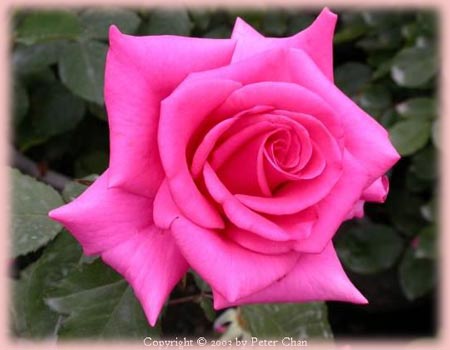
Hybrid Teas: These are the most popular roses, with long pointed buds, elegantly shaped flowers and usually one large bloom on a long cutting stem. The blooms are produced all season long and last well when cut. The flowers are most beautiful when half to three-quarters open. Hybrid teas are available in every color imaginable except for blue and black. Hybrid tea plants often have sparse foliage and tall, leggy stems that can reach 6 to 8 feet in height. These roses are grown for the glory of their flowers. They are not attractive as landscape plants.
Floribundas
Floribundas: These roses rebloom well in a wide range of bright colors. Floribundas are usually shorter and bushier than hybrid teas. The flowers are smaller and held in clusters but produced in great quantity. They are rarely fragrant but are very good as landscape shrubs.
Grandifloras
Grandifloras: These roses are vigorous, and produce large beautiful blooms and pointed buds like Hybrid Teas with the hardiness and flower clusters of the shrubbier floribundas. Grandifloras generally are tall, slender plants.
Miniature Roses
Miniature Roses: Miniatures range in height from 8 to 24 inches and have small buds, stems, foliage and flowers. They are ideal for landscape borders, ground covers and potted indoor plants or hanging baskets. Miniature roses are a way to have a variety of blooms in a small space. They are grown on their own roots, so the suckers that come up are the same named variety.
Hybrid Musk Rose
Hybrid Musk Roses: Hybrid musks are large (5 to 6 feet or taller) shrubs of graceful, arching habit. They have attractive, leathery foliage and bloom in clusters of many small to medium-sized flowers. Most are highly fragrant, with fruity scents that carry a good distance. They have disease resistance and will grow in filtered shade.
Modern Shrub Roses
Modern Shrub Roses: These roses are vigorous and hardy. They are attractive not only for their bloom, but also as landscape shrubs, with beautiful foliage, form and often bright stems and hips. Shrub roses are generally easier to maintain than other modern roses, requiring much less pruning. Many have good disease and pest resistance.
English Roses
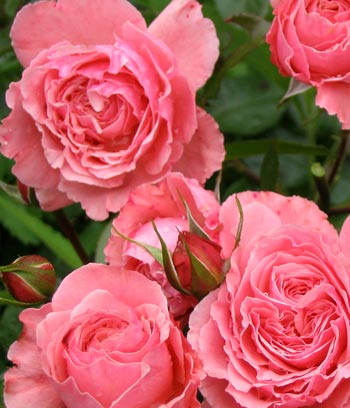
English Roses: English roses are a group of roses introduced in 1969 by the English rose hybridizer David Austin. They have the full flower form and fragrance of old roses but bloom repeatedly and come in more colors. English roses are often classed as shrub roses and many are good landscape plants. They are often billed as disease resistant but this is generally not the case in the South.
Climbing Roses
Climbing Roses: Climbers are vigorous growers that send out long shoots or canes which can be trained over fences, arbors or trellises. They are grouped into several types, with much overlapping among types.
Ramblers
Ramblers: This type of climbing rose blooms only once in late spring or early summer, with many clusters of small roses. Ramblers are very hardy and rapid-growing, as much as 20 feet in a season.
Large-Flowered Climbers
Large-Flowered Climbers: These climbers are slower-growing, are often trained on posts or some other type of support and may require heavy annual pruning. Many are sports (mutations) of shorter modern roses. Climbing hybrid teas do not bloom as continuously as do their bush parents, but flowers and foliage usually are identical.
Old Roses
Old Roses: Old roses include all rose groups developed before the introduction of the first hybrid tea rose. These plants are grown for their historic interest, color, fragrance and ability to survive adverse conditions. Old roses are divided into groups descended from European roses and those descended at least in part from Chinese rose.
European Roses
European Roses: European roses are almost all spring bloomers that have one flush of bloom a year. Their colors are primarily whites, pinks, reds and purples. Many are extremely fragrant. They are quite cold hardy, but may not adapt well to hot areas. European roses include gallicas, damasks, albas, centifolias, and moss roses.
Gallica Roses
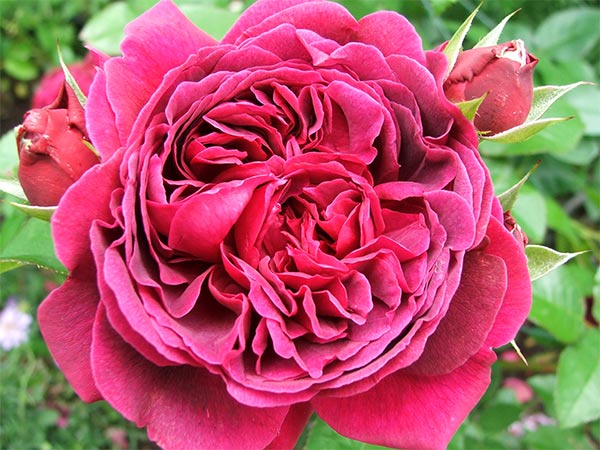
Gallica Roses: Gallicas are stocky, upright shrubs with fine prickles and deep green foliage. Some gallicas have simple single or semi-double blooms; others are very double, with swirled or intricately quartered petals. Many are highly fragrant. Flower colors are mainly deep pinks, crimsons and purples. Striped and mottled varieties are common.
Damask Roses
Damask Roses: This is a very old group. They are taller plants than the gallica roses, with grayish-green foliage. Their habit is usually graceful and arching, spreading under the weight of many flowers. Damasks have large blossoms with a strong, distinctive fragrance. They range in color from white to deep pink. Damask roses are not adapted to the heat of the coast and lower Piedmont.
Damask Perpetual Roses
Damask Perpetual Roses: These are also called Portland roses. They were the only repeat-blooming roses until the introduction of the China roses. They are stocky, healthy bushes, with double, fragrant blossoms set in a ruff of leaves. The colors range from white through all the pinks to deepest red.
Alba Roses
Alba Roses: Albas form tall shrubs with smooth stems arching up to 8 feet. They have few thorns. The albas have dense, bluish green foliage. They are very attractive garden plants, even when not in bloom. Their fragrant blossoms are generally white to blush pink. Albas are resistant to disease and grow into large, healthy shrubs. Albas are unusual shade-tolerant roses. They will grow in the open shade of a north-facing wall or under tall trees.
Centifolias
Centifolias: Centifolias are the ‘Cabbage Roses’. They are thorny, open bushes to 4 to 5 feet high. The very large, double and fragrant blossoms are borne so freely that they cause the plant’s branches to nod under their weight. Colors range from white to deep rose-red, sometimes striped and spotted.
Moss Roses
Moss Roses: Mosses are sports of centifolia and damask roses. Their flower stalks and buds are covered with a mossy growth that exudes a balsam scent. Moss roses are susceptible to powdery mildew.
Chinese Roses
Chinese Roses: Chinese roses introduced reblooming ability to roses and quickly became very popular. In addition to reblooming ability, the roses included warm colors of yellow and scarlet. Although most were not cold hardy, they are beautiful plants, and well-adapted to heat. The rose groups descended from Chinese parentage include Chinas, Bourbons, Perpetuals, Noisettes and Teas. Many of these do well in the South.
China Roses
China Roses: Chinas bear loose, semi-double flowers on graceful, wiry stems with red-tinted foliage. China roses are healthy plants, with compact growth. They rebloom throughout the growing season. Chinas range in color from deepest red and maroon through pink to white. Some hybrids also have warm tones of yellow, saffron, salmon and orange. They are rarely fragrant and are sensitive to cold, but most grow well in all of South Carolina except the mountains. Chinas are especially well-suited to growing near the coast.
Bourbon Roses
Bourbon Roses: Bourbons are intensely fragrant. They grow into large shrubs exceeding six feet in all directions. They are susceptible to disease, but are grown for the beauty and fragrance of their prolific flowers and for their vigor. They range in color from deep reds through pinks to blush and white. Bourbons are well-suited to all areas of South Carolina, but will need extra care to control disease.
Noisette Roses
Noisette Roses: Noisettes originated in Charleston, South Carolina, during the first decade of the 19th century. They are tall shrubs or vigorous climbing roses with elegant, slender foliage. The flowers are in pastel colors including lovely soft yellows that are very rare in old roses. Noisettes are strong, healthy growers but not hardy in cold winters. Several cultivars will grow throughout South Carolina, while more tender sorts will do best on the coast. Noisettes are exceptional for repeat bloom, beauty of flowers and fragrance.
Tea Roses
Tea Roses: Tea roses have exquisite, soft-colored blooms and excellent repeat bloom. Growth is slender and wiry like the Chinas. Their foliage is typically shiny and delicate. They have a unique tea scent. Teas are often tender, and not all will grow well in the colder parts of the state.
Hybrid Perpetuals
Hybrid Perpetuals: These roses will grow to be large, vigorous bushes if given good care. The large, fragrant flowers range in color from blush white to deepest red and purple. Many cultivars can be grown as pillar roses or short climbers. Hybrid perpetuals especially the dark red varieties, are susceptible to blackspot and powdery mildew.
Species Roses
Species Roses: Wild roses range from prostrate shrubs to enormous climbers. Their flowers range in color from white through all shades of pink to deep crimson. A few species are bright yellow. Species roses often have single blossoms and bloom once during the growing season. They are often very graceful landscape shrubs. Most are very hardy and disease-resistant. A few of the species roses that grow well in South Carolina include the Lady Banks roses, Cherokee rose and the sweet briar rose.
Rugosa roses
Rugosa roses are a tough, disease-free group of roses that have repeat bloom and a wonderful spicy scent. They will grow best in the cooler part of the state.